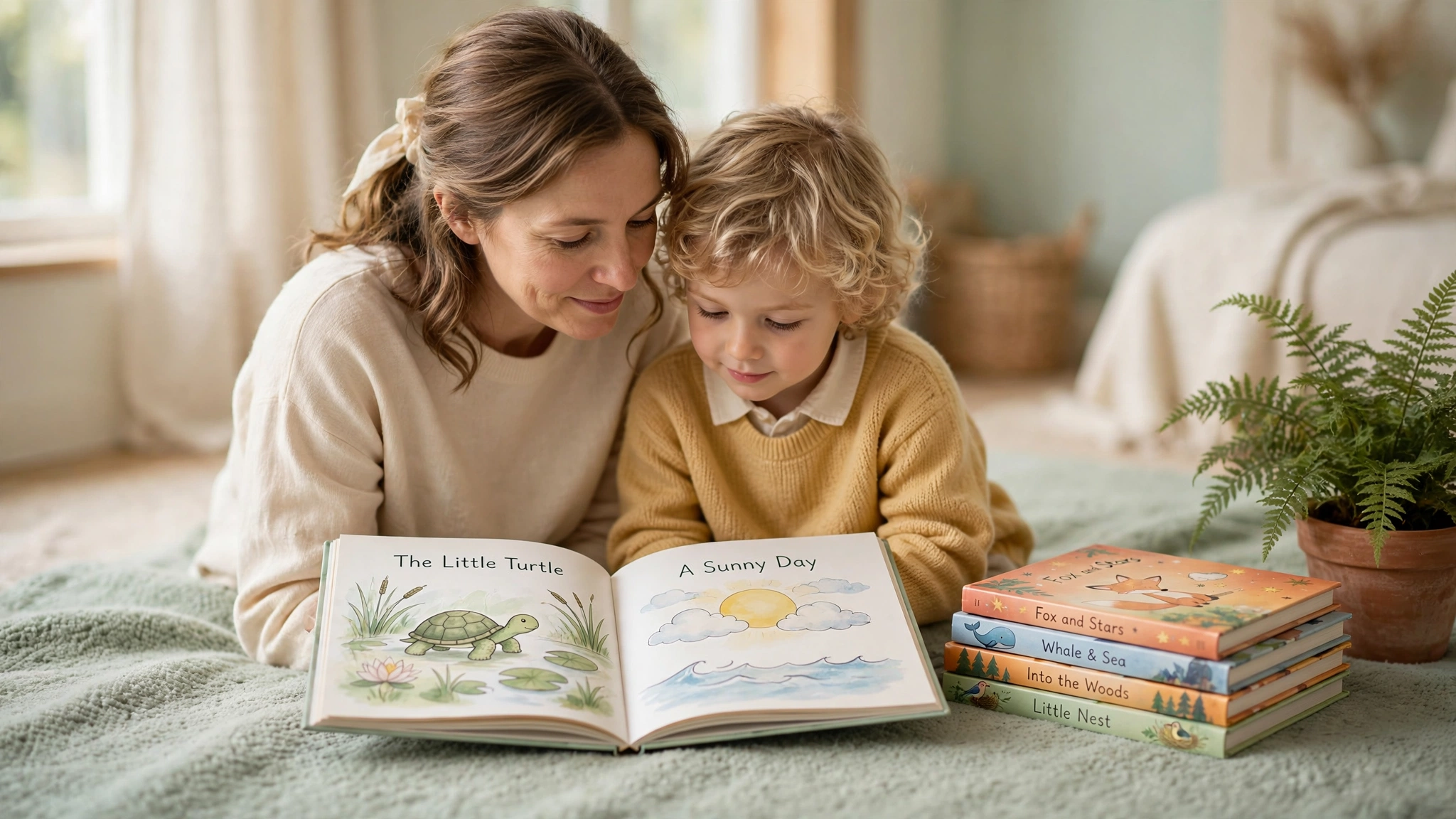
A bookshelf full of titles about autism can feel like a test you did not study for. Some books are warm and affirming. Others describe autistic children as problems to fix. Most do not say which kind they are on the cover.
This guide gives you a way to decide. You will find a question to ask before you buy, six checks to run on any book, advice on following your child's interests, and a clear line between books for your child and books for you. It does not rank titles. The right book depends on your child, and you know your child best.
Start with the question: what should this book do?
Parents often search for "the best books for autistic kids" when they really have a narrower need. Naming the job first makes every later choice easier. A book can do one of several things:
- Give you both a good time. A story your child loves, shared at bedtime or after school, is a complete reason to own a book.
- Reflect your child back to them. Stories with autistic characters who are the heroes of their own lives can help a child feel seen.
- Prepare for a specific situation. A first dentist visit, a new classroom, or a change in routine can be easier when a child knows what to expect.
- Explain your child to others. Siblings, cousins, and classmates sometimes need a respectful, accurate picture of what autism means.
- Support you. Some books are written for the adults who care for an autistic child, and they belong on a different shelf than the picture books.
A single book rarely does all five. Pick the job, then choose the book.
Six checks before you bring a book home
1. How does it portray autism?
Look at who the book is about and who made it. A supportive book shows an autistic character as a whole person with interests, strengths, and hard moments, rather than a list of deficits. Be cautious when a story treats autism as something to overcome or when the only thing a character does is struggle. Books written by autistic authors, or developed with autistic consultants, are a good place to start, and a short author note often tells you how the book was made.
2. How much text is on each page?
Match the amount of language to your child's current comfort, not their age or grade. Short, repetitive, predictable text suits some children. Others prefer dense nonfiction with captions and diagrams. Neither is a lower choice. Flip through a few pages and picture your child reading or listening.
3. What do the illustrations ask of your child's eyes?
Some children enjoy a page packed with small details to hunt through. Others find the same page overwhelming and prefer one clear image and plenty of white space. Some like realistic photographs, others like simple cartoons. If you know your child's visual preferences, use them. If you do not, watch which pictures they linger on in a library book.
4. Does the format fit your child's senses?
Format shapes the experience as much as story does. Board books hold up to heavy handling. Lift-the-flap and textured books invite touch. Audiobooks and e-readers let a child control volume, pace, and font size. Glossy pages, loud sound buttons, and strong paper smells bother some children and delight others. Treat the physical book as part of the decision.
5. How intense is the emotional content?
Plot matters. A story built around a loud argument, a lost pet, or a character being laughed at can be upsetting for a child who feels others' distress strongly. Read the book yourself first, or skim the ending, and decide whether it is right for now. You can always put it back on the shelf for later.
6. Does it fit how your child communicates?
Children who use speech, picture symbols, or an AAC device can all take part in reading together. Books with repeated phrases give a child a spot to join in, whether by speaking, pointing, or pressing a button. If your child uses visual supports, our guide to visual communication tools for autism explains how PECS and AAC fit into daily life.
Follow your child's interests
If your child loves trains, tide pools, or the planets, the best next book is probably about trains, tide pools, or the planets. Interest-led reading builds on what already holds your child's attention, and you do not need a special "autism book" for it to count.
There is research behind this instinct. A 2012 meta-analysis by Dunst, Trivette, and Hamby, published in Autism Research and Treatment, reviewed 24 studies covering 78 children aged 2 to 6 with autism. It found that interest-based practices were effective at increasing prosocial behavior and decreasing challenging behavior. The studies were small and focused on early intervention rather than book choice, so treat the result as support for building on a child's interests, not as a promise about any one book.
In practice, following interests can look like this:
- Choose nonfiction, field guides, and picture encyclopedias on your child's favorite subject alongside storybooks.
- Look for series with the same characters or format. Familiarity can make a new book easier to start.
- Let your child reread the same book as often as they like. Rereading is a legitimate way to enjoy a story and to practice language.
- Offer two or three books and let your child pick. Choosing is a skill and a form of respect.
- Allow your child to read in their own way, whether that means looking only at the pictures, flipping to a favorite page, or listening while they play.
Skip comprehension quizzes unless your child enjoys them. A book that feels like homework will stop being a place of comfort.
Books that prepare your child for what comes next
Some families use short illustrated stories to walk a child through a situation before it happens. This approach has a name and a research base. Social Stories were developed by Carol Gray, and a Social Story is defined by ten defining criteria that guide how it is written. More broadly, the AFIRM program at the University of North Carolina at Chapel Hill reports that, based on the National Clearinghouse on Autism Evidence and Practice's 2020 systematic review, social narratives meet the criteria for an evidence-based practice, supported by 20 single case design studies and one group design study.
For you, this means a story about a haircut or a school bus can be a useful tool when it is clear, calm, and written for your child. A generic book from a shelf may fit your child's situation only partly. If the story does not match your child's school, family, or sensory needs, consider writing a short one together, with real photographs and your child's own words. A speech-language pathologist, teacher, or behavior specialist who knows your child can help you shape it.
Books for children and books for caregivers
These two groups of books answer different questions, and mixing them up causes most of the confusion.
Books for your child
The goal is enjoyment, comfort, curiosity, and a sense of belonging. These books should never feel like a lecture. A child does not need to be taught that they are broken. A good children's book gives them a character to love and a story worth coming back to, and it may happen to feature an autistic child.
Books for you
Caregiver books answer adult questions: what autism is, what to do after a diagnosis, how to understand services, and how to speak up at school. Quality varies widely, so check the author and the framing. The Autistic Self Advocacy Network (ASAN) publishes Start Here: A Guide for Parents of Autistic Kids, created with the Autistic Women and Nonbinary Network, the Thinking Person's Guide to Autism, and Little Lobbyists. ASAN describes it as a resource that explains autism from an autistic perspective, and a free PDF is available alongside print and ebook editions.
When you read caregiver books, notice the language. Resources that talk about autism as something to be "overcome" can leave a parent feeling afraid. Resources that explain autism as part of who a child is tend to leave a parent better equipped to support them. For help with the school side, our Resources page, including its Books and IEP Support filters, collects guides and tools to explore.
Keep your reading and your child's reading separate. A parenting book is for your preparation. Do not read it aloud to your child as if it describes them.
How to read together
The best book can still go badly in the wrong moment. A few habits help:
- Pick a calm time. A regulated child takes in far more than one who is tired or overstimulated.
- Follow your child's lead. Pause on the pages they love, skip the ones they do not, and stop when they are done.
- Let your child move. Many children listen better while pacing, rocking, or holding a fidget. Movement does not mean they are not listening.
- Borrow before you buy. A library lets your child try a format or a series at no cost. Children's librarians often know which books suit different sensory and language needs.
- Keep a basket of favorites within reach. Easy access lets your child choose a familiar book when they need comfort.
A quick checklist
Before you buy or borrow, ask:
- What do I want this book to do for my child, or for me?
- Does it show autistic people respectfully, and was it made with autistic voices?
- Do the amount of text and the style of illustrations suit my child today?
- Will the format work with my child's sensory preferences?
- Is the emotional content right for this stage?
- Does it connect to something my child already loves?
If you can answer yes to most of these, the book is worth trying. If it sits unread, that is information about fit, not a failure on anyone's part.
Every shared story can be a thriving moment
The point of a book is the time it creates: a child leaning against your shoulder, pointing at a picture that makes them happy, asking for the same page again. Choose books that support that connection, follow your child's interests, and keep your own learning on a separate shelf. Small, steady choices like these build the calmer, more confident daily life you are working toward.
Sources
- Dunst, C. J., Trivette, C. M., and Hamby, D. W. (2012). Meta-Analysis of Studies Incorporating the Interests of Young Children with Autism Spectrum Disorders into Early Intervention Practices. Autism Research and Treatment, 2012, 462531.
- AFIRM, University of North Carolina at Chapel Hill. Social Narratives Brief Packet.
- Gray, C. What is a Social Story? Carol Gray Social Stories.
- Autistic Self Advocacy Network. Start Here: A Guide for Parents of Autistic Kids.
